

What does Jesus mean when He says, “You are the salt of the earth” (Matthew 5:13)?
Here’s one way to look at it. Salt is an indispensable part of our diet. It is essential to life. In the same way, our witness of Christ is essential to bringing people to eternal life in Him.
So, live out the life of Christ! Be imbued with His Spirit! Let your life convict the world of the reality of Christ and of their need for Christ through your presence and how you live.
Now that is all wonderful and true, but is that how men and women in Jesus’ day would have understood Jesus’ words?
Eugene P. Deatrick, the former head of the soils department at West Virginia University, has a different take.
Eugene argues that when Jesus speaks of salt in Matthew 5:13, Mark 9:50, and Luke 14:34–35, He is not speaking of salt’s household use but of its agricultural use.
Wait! Agricultural use? You don’t “plant” salt, do you? You don’t grow it, do you? So, what does “salt” have to do with agriculture?
According to Eugene Deatrick, salt in the days of Jesus was used like we use fertilizer. It was used to make stuff grow!

Like how we use “fertilizer today?” Yes! That’s exactly what Eugene believes. God wants us to be the salt of the earth, the “fertilizer” of the earth so that His kingdom will grow!
So where does he get that from?
Well, Eugene Deatrick points out that “agricultural literature abounds in references to the use of salt as a fertilizer.”
As a matter of fact, the value of salt for agricultural purposes is referenced by Cato, Virgil, and many others in ancient times.
When you think of “salt” in this way, it sheds new light on many Bible passages that refer to salt. “’Therefore, salt is good; but if even salt has become tasteless, with what will it be seasoned? It is useless either for the soil or the manure pile, so it is thrown out. The one who has ears to hear, let him hear’” (Luke 14:34-35 NASB). It is useless for the soil. That means it’s meant to be useful for the soil!
It is also useless for the manure pile. Ever wonder about that? Cause the implication is that it should have a use for the manure pile.
Nowhere does it say it’s useless for baking, cooking, seasoning, or preserving food.
Only two uses are listed here: the soil and the manure pile.
In Matthew 5:13 and Mark 9:50, Jesus again refers to salt in a way that makes more sense as an agricultural usage than as a food additive.
Did you know that most salts in Jesus’ day were mixtures of the chlorides of sodium, magnesium, and potassium, with very small amounts of calcium sulfate (gypsum)? Definitely not table salt stuff.
These hardier, “saltier” salts were generally more valuable in an agricultural context because their benefits would last longer and because simply getting enough yield from your crops was critical to avoid starvation.
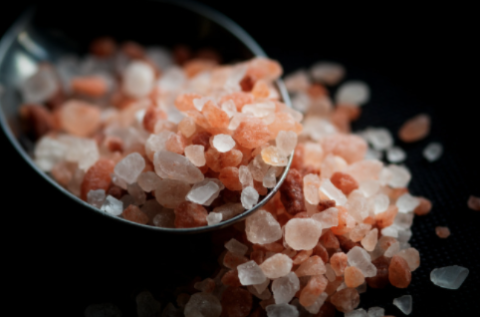
When Jesus talked about salt losing its “saltiness” or “savor,” He was referring to the process by which the compounds in these agriculturally oriented salts disintegrate over time. Disintegrated salt loses some of its gypsum. This change in saltiness makes it less effective as a fertilizer.
So, when Jesus talked to his followers about losing their saltiness, He was pointing out that they were losing their fertilizing properties, their ability to bring about life and growth around them!
And if Jesus wasn’t talking about table salt but fertilizing salt, that means that His reference to “the salt of the earth” in Matthew 5:13 can just as easily be translated as “salt for the soil.”
This makes better sense of Jesus’ words in Luke 14:34–35 (NIV): “Salt is good, but if it loses its saltiness, how can it be made salty again? It is fit neither for the soil nor for the manure pile; it is thrown out.”
The reference to the manure pile has long been a source of confusion when viewing salt as seasoning. I mean, Jesus is implying that if salt IS good, then a good use for it is to put it on a manure pile?
What? When’s the last time you did that? Hmmm, got some really salty salt I hear. Where’s a manure pile I can dump it on?
Jesus’ saying makes more sense when we realize that salt preserves the fertilizing properties found in the manure pile.
Now if you pulled out your 19th- century agricultural reference volume notes, they would say, “Where fermented dung cannot be carted at once to the field, covering that heap of manure with salt is a cheap and effective means of checking fermentation, which will keep the dunghill from rotting and becoming useless as fertilizer. The salt will also enhance the fertilizing properties of the manure.”
This is a centuries-old, tried-and-tested agricultural use of salt that fits the Biblical passages and the ancient world much better than interpreting these references to salt as table salt.
Not only did the ancient Hebrews use salt in this way, but the Chinese and early Romans did as well. Salt was used in arid places to help soil retain moisture, destroy weeds, make stubborn soils easier to till, and make sour grass sweeter and more appealing to cattle. In some soils, salt keeps rust from wheat and blight from potatoes. When applied properly, salt will kill surface weeds while allowing more deeply rooted plants and grass to thrive. And when rain or irrigation allows salt to permeate the soil, the salt chemically releases vital minerals and nutrients, allowing them to nourish plants.
This may be a foreign concept to us in the West, but it is still well-known in other parts of the world. For example, the Philippine Coconut Authority recently released a technology guide sheet for farmers titled, “SALT (Sodium Chloride): An Effective and Cheap Fertilizer for High Coconut Productivity.”
The guide notes that salt accelerates crop growth and development, increases yield, minimizes plant damage, and promotes environmental sustainability. According to the guide, between 1991 and 1997, farmers who fertilized with salt saw a 125 percent increase in yield compared with unfertilized coconuts.
This understanding of salt being mixed with manure and then used as a fertilizer changes how we view Jesus’ command to love our neighbor.
It adds a deeper dimension to what Jesus is saying! It becomes a source of inspiration for Christian life and mission. For we are called to be more than just a preservative in society.

The followers of Jesus Christ are sent on a mission to the parts of the world that are the most barren. There they are to be mixed into the manure piles of the world so that God can use the power of our presence to spark new & virtuous life in HIM!
But if we are not committed to the radically countercultural message of Jesus Christ, we lose our “saltiness!”
The “saltiness” is our personal unique witness to the power of the gospel in our life. That saltiness, that power of the gospel, can stimulate life in others and bring to them godly growth. That is how the kingdom of God can transform the mess pits, the manure piles of this world.
If we lose our “saltiness,” we’ve got nothing to share! We will fail to be the agents of change that Jesus calls his followers to be (Matthew 5:13).
If the agricultural use of salt makes barren soil easier to till, facilitates plants' absorption of other vital nutrients, and maintains and enhances the fertilizing capacity of manure, then Jesus is calling us to something extraordinary and countercultural.
If we are truly supposed to be salt in the agricultural sense, that means we are supposed to get messy and go where nothing is growing right now. Instead of going where things are bright, new, and exciting, we have a call to explore opportunities that probably won't make sense to “normal” people.
Being salt and light for the good of the world sets us free to love our neighbors without feeling like we’re missing out or “not living up to our potential.”
When we realize we are fertilizer, we measure our value by the growth of others, not by our comfort or vocational success. We also recognize that we need to be scattered where the soil most needs fertilizing. We need to be in close relationships with people who do not know or believe the gospel so that new life in Christ might grow where there is now only barren soil.
An agricultural understanding of Jesus’ call for us to be the “salt of the earth” sheds light on some of the most important issues facing Christians today.
Questions about evangelism, justice, cultural engagement, and social responsibility gain a surprising clarity when considered in terms of promoting the life and flourishing of others. This view of the “salt of the earth” encourages us to discern where God is leading us by considering how our gifts and interests intersect with the barren places and the manure piles of our world.

There are lifeless sections of soil in every small town, big city, and suburb in America. There are friends and family members whose lives are in a state of disaster.
Financial issues, addictions, oppression, injustice, poor decision-making, ignorance, or outright rejection of the gospel are all too common. A whole host of messy problems plague the lives of those we care about.
Call to Action
The call of the salty is the call to move toward the broken so that they may meet God and be set free to become who God wants them to be.
As salt, we are intended to bring life and flourishing out of arid soil where nothing grows—spheres of society that are dead, barren, or rotting because Christians are not there.
Wherever the world is not the way God in His goodness intended it to be, that is where we should be encouraging and training one another to go. The good news is we don’t have to go far to find opportunities to be salt.
No matter where God sprinkles us, grace gives us the means and love gives us the motive to live salty lives consistent with Jesus’ teaching for the benefit of others and the glory of God.
Unless noted otherwise, scripture taken from the New King James Version®. Copyright © 1982 by Thomas Nelson. Used by permission. All rights reserved.
Scripture quotations taken from the (NASB®) New American Standard Bible®, Copyright © 1960, 1971, 1977, 1995, 2020 by The Lockman \ Foundation. Used by permission. All rights reserved. www.lockman.org
Scripture noted as NIV above is taken from the Holy Bible, New International Version®, NIV®. Copyright ©1973, 1978, 1984, 2011 by Biblica, Inc.™ Used by permission of Zondervan. All rights reserved worldwide.