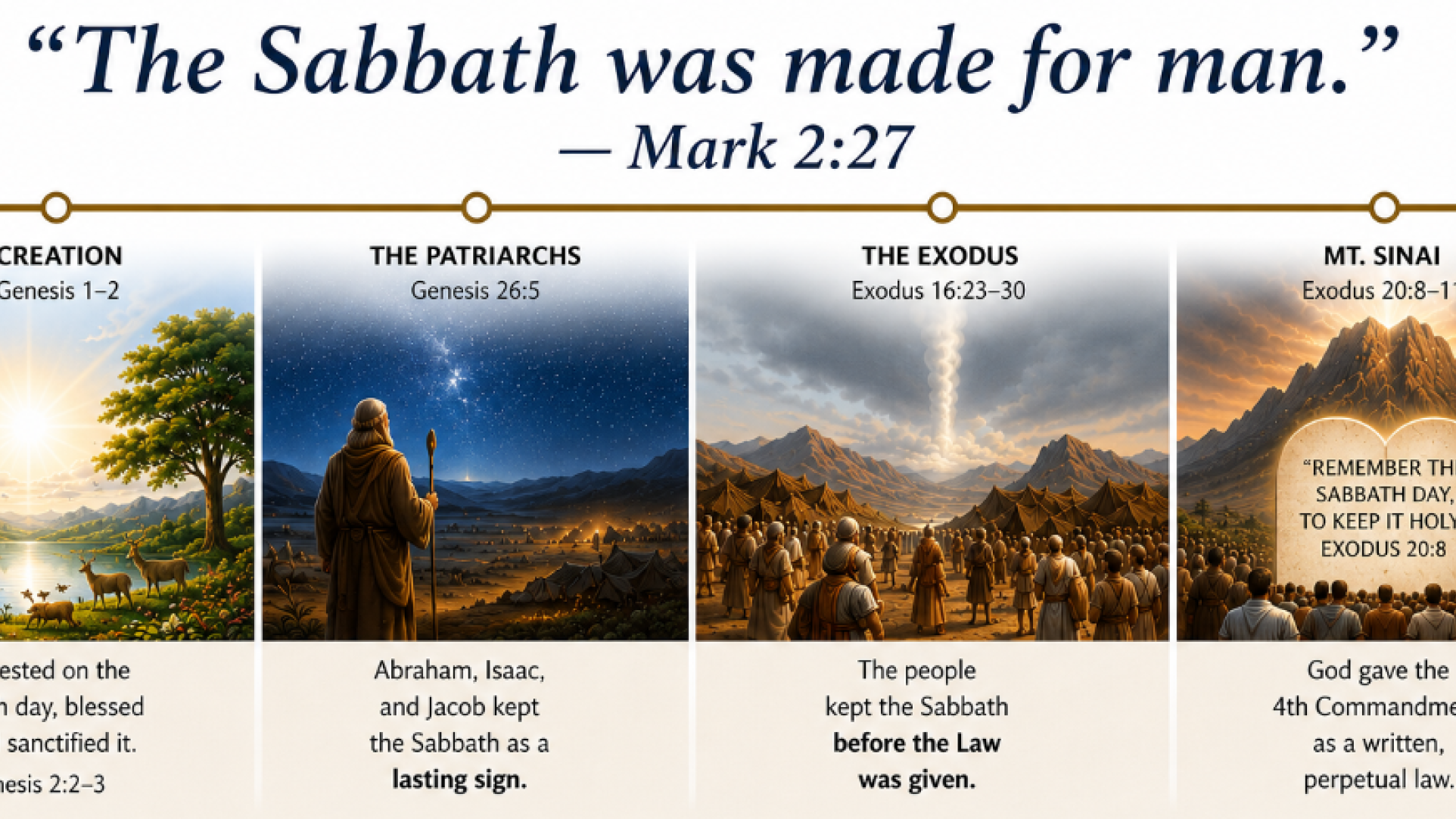

From Creation to Sinai
“You alone are the LORD; You have made heaven, The heaven of heavens, with all their host, The earth and everything on it, The seas and all that is in them, And You preserve them all.”
Nehemiah 9:6 (emphasis added)
In Part 1, we looked at the purpose of the Sabbath and saw how the Sabbath was not just a day for physical and mental rest, but that its purpose was to be a sign that we are God’s people and that He, the Creator and Savior, is our God.
In Part 2, we looked at the establishment of the seventh-day Sabbath at creation as a perpetual institution for humanity, evidenced by the preserved seven-day week and by God’s unique actions of resting, blessing, sanctifying, and delighting in the seventh day alone. It further contends that Scripture never transfers these attributes to any other day, asserting that the Sabbath remains God’s continuing holy rest day intended for mankind’s blessing and observance.
In this article, we will look at the Sabbath from Creation to Mt. Sinai.
Contrary to popular belief, the Ten Commandments did not originate at Mt. Sinai or in the Old Covenant; they were instilled at creation. God’s law is His character. The Bible uses the same attributes to describe God as it does to describe His law.
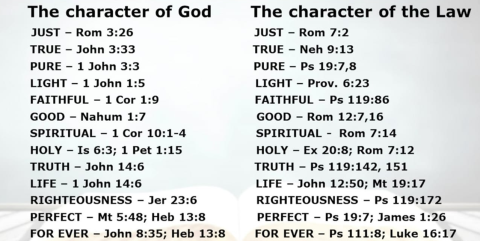
When God created Adam and Eve, they had this same character. “God made man upright,” (Ecclesiastes 7:29), and in His image (Genesis 1:26-27). God related His law (i.e., His character) to Adam and Eve, who in turn passed it on to their offspring, and they passed it on to their offspring, etc. This is why in Genesis, 430 years before Mt. Sinai, God said, “Abraham obeyed My voice, and kept My charge, My commandments, My statutes, and My laws” (Genesis 26:5, emphasis added). Abraham didn’t just keep God’s commandments himself, but he taught his children: “For I have known him, in order that he may command his children and his household after him, that they keep the way of the LORD, to do righteousness and justice…” (Genesis 18:19). Abraham could not have kept God’s commandments, statutes and laws, and taught his children, 430 years before Mt. Sinai if they had not already been communicated to him.
So, while Mt. Sinai may be famous for God handing His Ten Commandments to Moses, His law was made known thousands of years beforehand. This is how Cain knew that he was breaking the law by killing his brother. In fact, before Moses trekked up Mt. Sinai, the Bible references all Ten Commandments:
- 1st – Genesis 35:2-4.
- 2nd – Genesis 31:19-34.
- 3rd – Exodus 3:5-6, 5:1-2, 8:10-13, 9:13-14, 29-30, 10:1-2.1
- 4th – Genesis 2:1-3.
- 5th – Genesis 9:22-27, 37:28-35.
- 6th – Genesis 4:8-13.
- 7th – Genesis 39:9.
- 8th – Genesis 44:4-10.
- 9th – Genesis 3:4.
- 10th – Genesis 4:3-5, 12:10-20
Even the Israelites kept the Fourth Commandment before Mt. Sinai. When Moses returned to Egypt after God appeared to him at the burning bush, he reminded the people of God’s holy Sabbath day, and the Israelites began to rest on God’s Sabbath. Pharaoh was not happy about his slaves taking off on Sabbath and told Moses, “You make them rest from their labor!” (Exodus 5:5).
Upon exiting Egypt, on their way to Sinai, God again taught them to observe His Sabbath. “Then the Lord said to Moses, ‘Behold, I will rain bread from heaven for you. And the people shall go out and gather a certain quota every day, that I may test them, whether they will walk in My law or not. …’” (Exodus 16:4). They were told to gather manna on six days, with a double portion on the sixth day, but that no man may gather on the seventh day. “So the people rested on the seventh day” (Exodus 16:30). That wouldn’t be a very fair test if the Sabbath command had not even been given yet. Notice how God mentioned seeing if they would walk in His law weeks before He wrote the tablets of stone.
Yet, when some of the people profaned the Sabbath during that march to Sinai, by seeking manna on the seventh-day Sabbath, God asked, “How long do you refuse to keep My commandments and My laws?” (Exodus 16:28).
These passages prove a few things:
- God had commandments and laws before Mt. Sinai, even before providing the manna.
- That in God’s law before Sinai was the holy Sabbath, as it was the Sabbath law that was violated when they searched for manna on the seventh day.
- That God wanted to test them on obedience to His law, and used the Sabbath law as that test.
- That the seven-day week cycle had been preserved and kept, since the Israelites knew when the sixth day arrived, and they gathered double on that day.
- That the obligation to observe the seventh-day Sabbath existed well before the manna test, since when the people broke the Sabbath on the first Sabbath there was no manna, God used language as if they had been breaking the Sabbath for a long time. “How long do you refuse to keep My commandments and My laws? (Exodus 16:28).
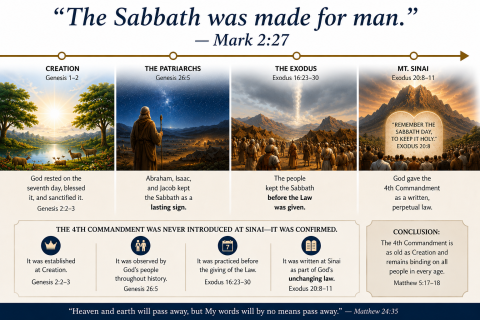
The evidence from Scripture is clear: God’s law did not begin at Mt. Sinai, nor was the Sabbath an obligation that arose in the Ten Commandments. From creation, God placed His character and moral law before mankind, and the seventh-day Sabbath stood as a holy memorial of His creative power and His desire for fellowship with humanity. Long before the tablets of stone were written at Sinai, faithful men like Abraham knew God’s commandments, taught them to their children, and walked in obedience to them.
Mt. Sinai, therefore, was not the origin of God’s law, but a written affirmation of principles already established from the beginning. The seventh-day Sabbath was known before Sinai, observed before Sinai, and tested before Sinai because it had already been established, blessed, and sanctified by God at creation. The same God who rested, blessed, and made holy the seventh day has never removed that blessing or transferred that holiness to another day. His law remains a reflection of His unchanging character, calling His people in every generation to love Him, obey Him, and enter into the rest He established from the foundation of the world.
Call to Action
God still uses the Sabbath as a test of loyalty, revealing who will worship the Creator rather than “the gods that have not made the heavens and the earth” (Jeremiah 10:11). And today, as in the Wilderness of Sin, His question still echoes to His people: “How long do you refuse to keep My commandments and My laws?” (Exodus 16:28).
Will you choose to honor the Creator God by keeping holy His blessed seventh-day Sabbath day?
Scripture taken from the New King James Version®. Copyright © 1982 by Thomas Nelson. Used by permission. All rights reserved.
- God is Holy, and He reveals His name as I AM. God sent the plagues and removed them so that Pharaoh would know that God is the Lord of all things, and His name should not be treated with contempt or dishonored, as Pharaoh treated God in Exodus 5.